
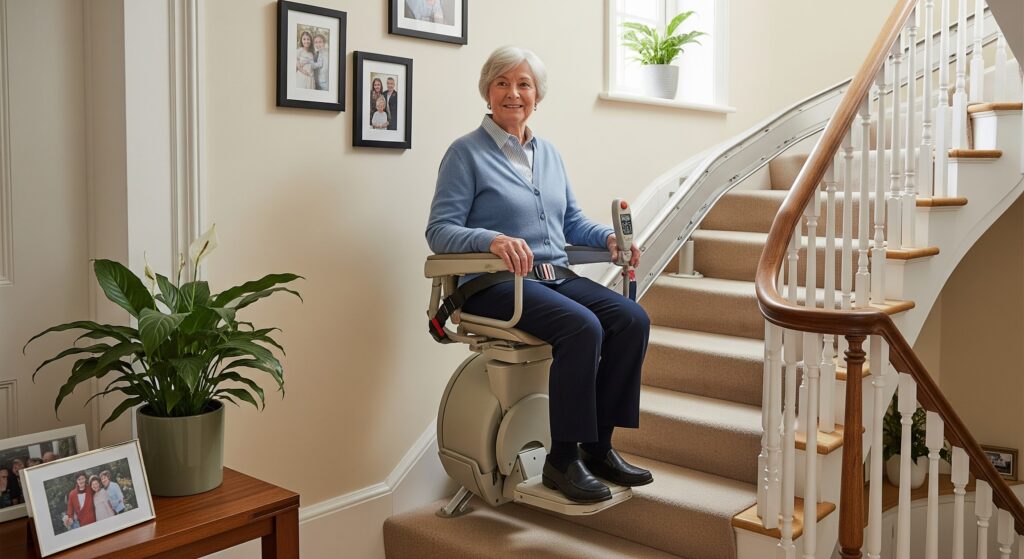
Stairlifts have become one of the most effective home accessibility solutions for people who struggle with stairs. However, they are not a one-size-fits-all answer. For families making decisions about safety, independence, and long-term mobility, understanding when a stairlift is truly the right solution—and when it may not be—is critical.
Making the wrong choice can lead to unnecessary costs, limited usability, or the need for additional modifications later. Making the right choice can restore confidence, prevent falls, and allow someone to remain safely in their home.
Below, we break down realistic scenarios where a stairlift works exceptionally well—and situations where alternative mobility solutions may be more appropriate.
When a Stairlift Is the Right Solution
Limited Mobility but Stable Sitting Ability
Stairlifts are ideal for individuals who:
- Can sit upright safely
- Have difficulty walking up or down stairs
- Experience joint pain, muscle weakness, balance issues, or shortness of breath
Conditions such as arthritis, Parkinson’s disease, multiple sclerosis, or age-related mobility decline often fall into this category.
The Home Has Multiple Levels Used Daily
If essential living areas—such as bedrooms, bathrooms, or laundry rooms—are located on different floors, a stairlift can eliminate the need to relocate rooms or consider moving altogether.
A properly installed stairlift allows safe, consistent access between levels without structural remodeling.
The Staircase Is Narrow or Curved
Many families assume stairlifts only work on straight staircases. In reality, modern stairlifts are custom-built to fit:
- Curved staircases
- Landings
- Spiral or irregular stair designs
Professional evaluations ensure the system fits the home without blocking walkways or compromising safety.
Fall Risk Is Increasing
Stairs are one of the most common locations for serious falls in the home. Warning signs include:
- Needing handrails on both sides
- Hesitation or fear when using stairs
- Previous near-falls or slips
Installing a stairlift before a major fall occurs is often far safer—and more cost-effective—than reacting after an injury.
The Goal Is to Age in Place
For individuals who want to remain in their home long-term, a stairlift can be part of a broader accessibility strategy that supports independence without major renovations.
When a Stairlift May Not Be the Best Solution
Inability to Transfer Safely
If a person cannot safely sit down, stand up, or transfer onto the stairlift seat—even with assistance—other solutions may be safer, such as:
- Residential elevators
- Vertical platform lifts
- First-floor living reconfiguration
Wheelchair Dependence Without Transfers
Stairlifts are designed for seated users. If someone relies entirely on a wheelchair and cannot transfer independently or safely, a stairlift may not meet their needs.
In these cases, platform lifts or elevators often provide better long-term accessibility.
Severe Cognitive Impairment
Individuals with advanced dementia or cognitive conditions may struggle to use a stairlift safely without supervision. Safety considerations must be evaluated carefully on a case-by-case basis.
Temporary or Short-Term Needs
For short recovery periods—such as post-surgery rehabilitation—a rental stairlift or alternative temporary solution may make more sense than a permanent installation.
This is why professional guidance is essential before committing.
Why a Professional Evaluation Matters
Every staircase, home layout, and mobility condition is different. A stairlift that works perfectly in one home may not be appropriate in another.
A professional accessibility evaluation helps determine:
- Whether a stairlift is safe and practical
- Which type and configuration is required
- Whether another mobility solution would provide better long-term results
At One Step Mobility, evaluations focus on real-life use, not just measurements. The goal is to recommend a solution that genuinely improves daily living—not one that creates new challenges.
Don’t Wait Until the Stairs Become Dangerous
Families often wait until a fall, injury, or emergency forces action. At that point, options can become limited and decisions rushed.
Addressing stair safety early allows:
- More solution options
- Better planning
- A smoother installation process
- Greater peace of mind
If stairs are becoming a concern, now is the right time to explore your options with experienced professionals who understand mobility—not just equipment.
Take the Next Step Toward Safer Living
Choosing the right mobility solution is about more than installing a product—it’s about protecting independence, dignity, and safety.
A stairlift may be the perfect answer. Or it may be a sign that another solution is needed. The only way to know for sure is through a proper evaluation.
Contact One Step Mobility to get clear, honest guidance and a solution designed for real life—before the stairs become a risk.